
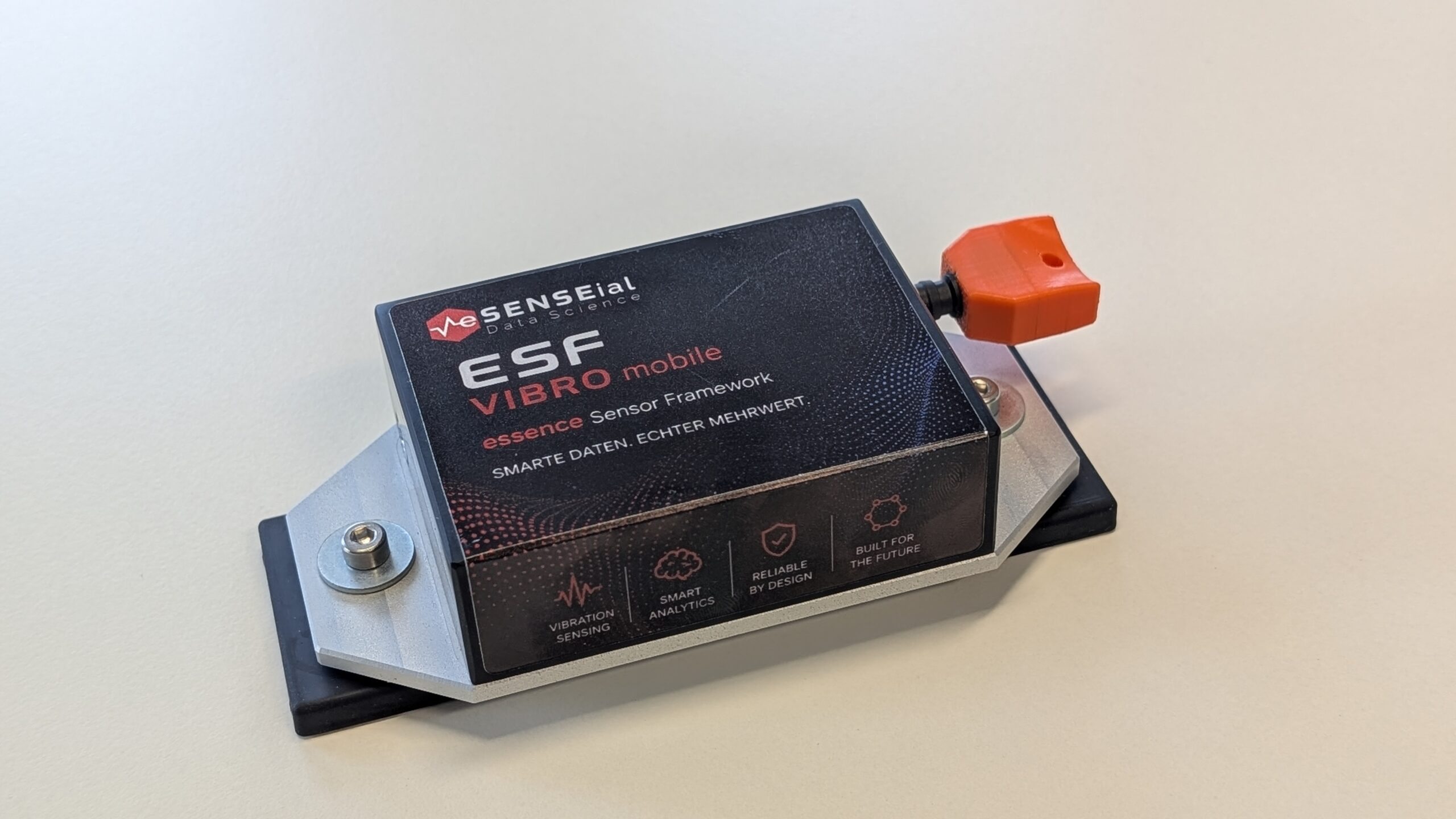
This summer, Julian supported us during his student internship with several tasks related to our sensor systems. He not only became familiar with our hardware and software, but also worked directly on real process steps – from assembling and testing sensors to analysing and documenting measurement data.
From component to ready-to-use sensor
At the beginning of his internship, Julian worked with our team to become familiar with the vibration simulator, the sensors we use and the corresponding eSENSEial applications. He then accompanied a batch of sensors through several stages: assembly, potting and provisioning in Graz, calibration, and finally testing, documentation, packaging and shipping. Along the way, he also looked at possible improvements to the existing workflow. A checklist that is still maintained manually today, for example, could in future be replaced by a database with an API and web interface. This would allow test steps to be completed in a structured way and required sequences to be technically enforced.
How a software update can affect measurement data
For another task, Julian compared two firmware versions of our sensors. To do this, he wrote a Python script that triggers measurements and visualises the results, and then documented the differences between the old and new versions. The test focused on the temporal synchronisation of multiple sensors. A sensor’s internal clock is not perfectly precise. When several sensors are used in parallel, their timestamps can therefore drift apart over longer measurement periods. In Julian’s comparison, three sensors were recorded simultaneously for ten seconds at a time, and the time offset between them was analysed.
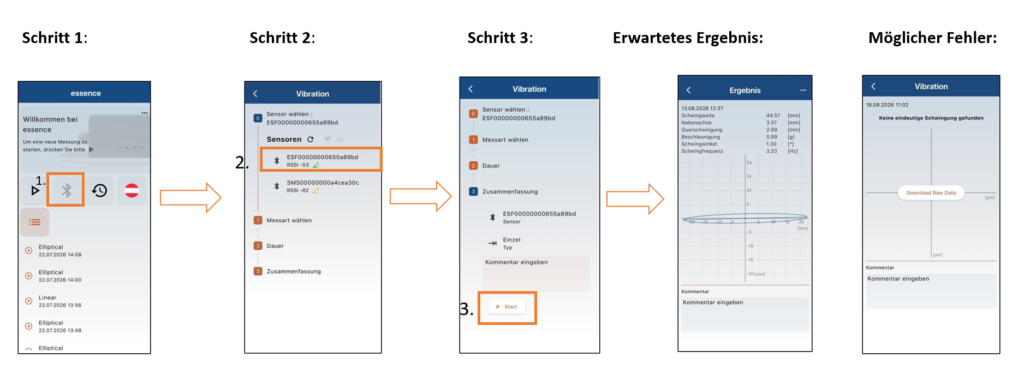
The test run: connect, measure, export data.
The difference between the two firmware versions was clear: with the older version, the measured time offset after ten seconds was up to 78.2 milliseconds. With clock correction enabled, the deviation in the same test was reduced to below 1.1 milliseconds. For Julian, this was one of the most interesting results of his work.
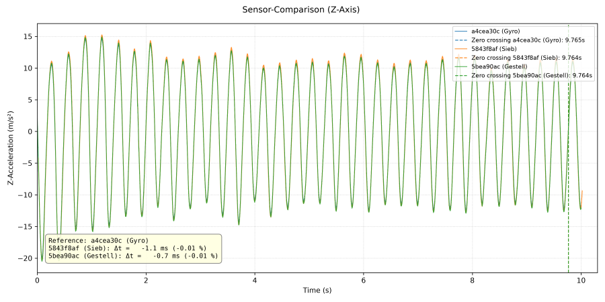
Almost perfect synchronisation.
The vibration signals from the implemented sensors (blue, yellow and green) move almost perfectly in sync.
Hardware, software and data belong together
According to Julian, what interested him most during his internship was the practical assembly and setup of the sensors. At the same time, his tasks provide a good example of how closely hardware, software and data are connected in our projects.
For us, this is exactly where data science begins: a sensor has to work mechanically, be configured correctly and communicate reliably. The software has to provide the expected data, and only through careful testing and analysis can we determine whether the overall system is actually working as intended.
Thank you, Julian, for your support and commitment this summer – and all the best for what comes next!