
When people think about digitalisation, they often think of an app, a dashboard or an attractive visualisation. But the visible result is usually only the final step. Turning data into genuinely useful information takes much more: reliable data sources, functioning interfaces and a connection between IT, automation and data science.
The data is often already there
Many companies already generate large amounts of data – in machines, plants, control systems or existing IT systems. So the first question is not always: How can we collect more data? More often, it is: How can we make use of what is already there? And where information is missing, additional sensors can help. But that is not always as simple as it sounds. Sometimes, there simply is no off-the-shelf sensor for a specific application: existing solutions may be too expensive, unnecessarily precise, incompatible with existing systems or not robust enough for harsh industrial environments. This is where our innovation work begins.
From problem to working prototype
In our Production Studio, we develop our own hardware solutions when required – using 3D printing, milling or laser cutting. This allows us to turn ideas into prototypes quickly and test them directly on site. Instead of spending a long time developing a theoretically perfect solution, we can create a Minimum Viable Product early on: a solution that demonstrates under real-world conditions whether the chosen approach works and what added value it actually provides. We advise on the selection of suitable sensors, support their installation and create the necessary interfaces to existing systems. Our principle is simple: if something already works for the customer, there is no need to replace it. Instead of adding another monolithic system, we connect existing and new systems as flexibly as possible under one common framework. The solution should adapt to the application – not the application to the software.
And sometimes it simply starts with a glass door
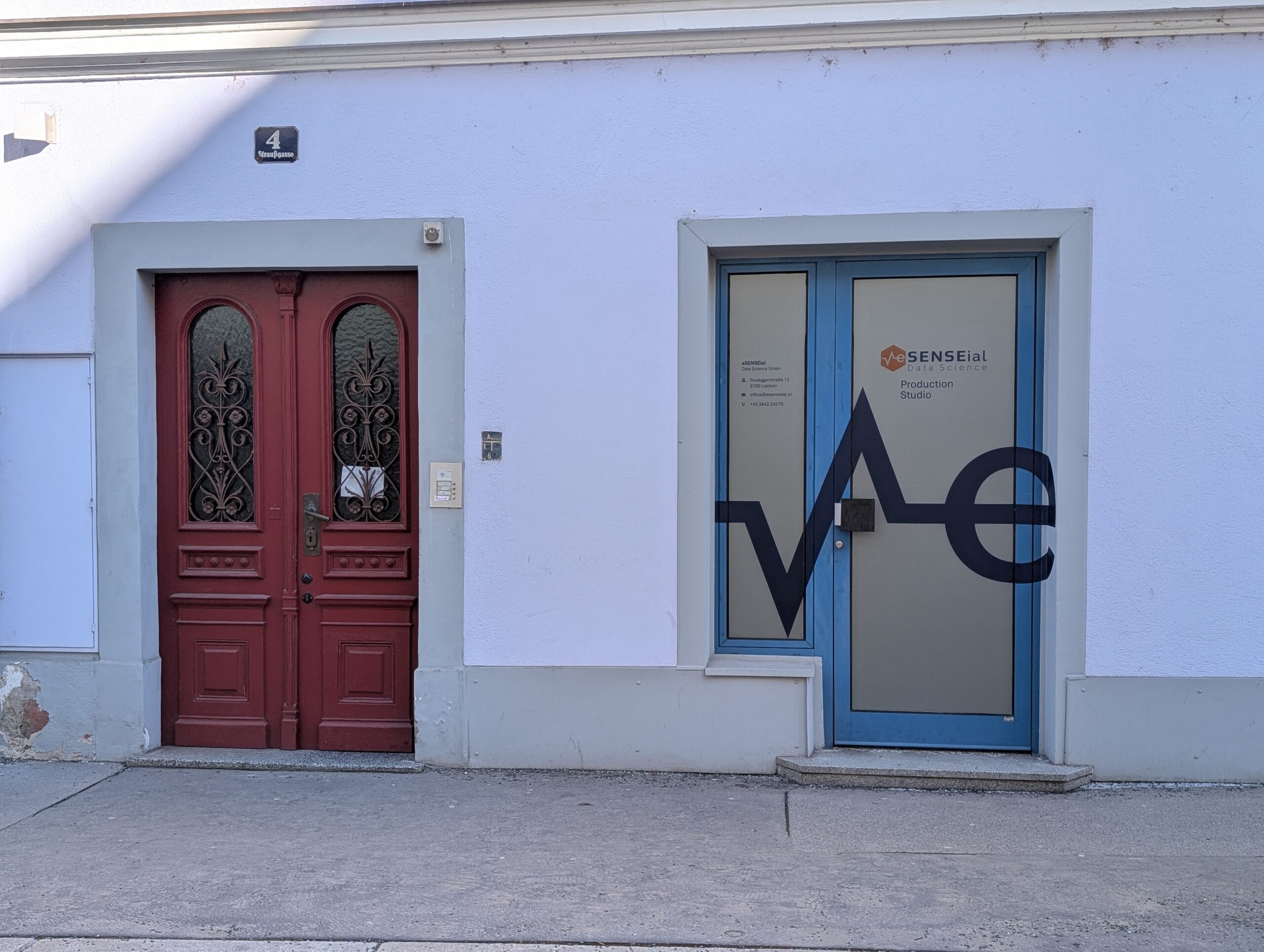
We are particularly pleased that our Production Studio has also started attracting curiosity from outside the company. An apparently rather eye-catching branded glass door in Leoben’s Straußgasse prompted the Kleine Zeitung to take a closer look at what is actually behind it. The result was an insight into our Production Studio, our work and the question of how we bring knowledge and new technologies from research and development into industrial practice.
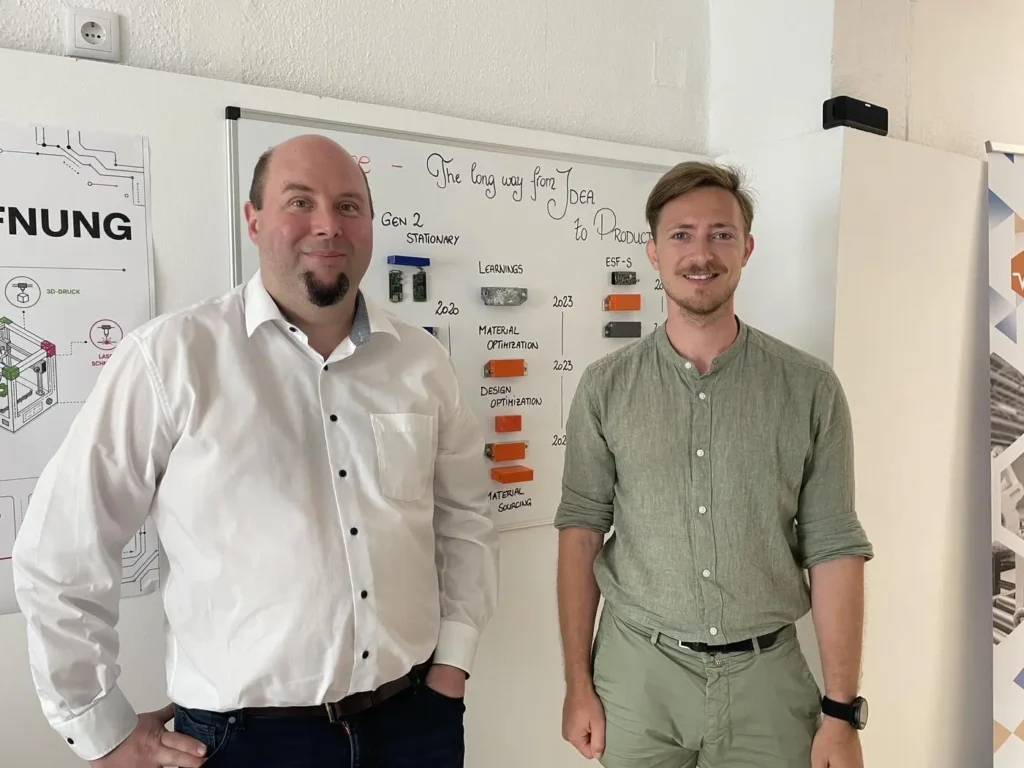
It is nice to be noticed!
In the photo: Managing Director Michael Habacher and Head of Production Studio Philipp Peterseil
(C) KLZ / Verena Strobl
Turning data into knowledge
Sensors, hardware and interfaces provide the foundation. The actual “brain” of the solution is statistics and mathematics. Using data science methods, we connect data, identify patterns and turn them into useful information. We then make the results available to our partners and the relevant decision-makers where they are needed – for example in the form of reports, notifications or visualisations. Because for us, digitalisation is not about collecting as much data as possible.
Digitalisation means turning the right data into knowledge that genuinely helps people in their day-to-day work.